


Shah Abbas the Great
By Shapour Ghasemi 2025
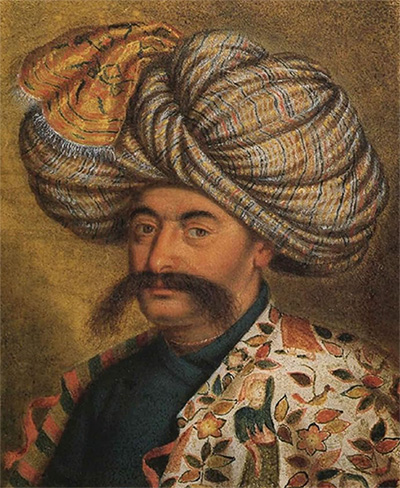
|
| Shah Abbas the Great |
Abbas I was born on 27 January 1571 in Herat, where his father, Mohammad Khodabanda, served as governor. He was the third son of Mohammad Khodabanda and his wife, Khayr al-Nisa Begum. Commonly known as Abbas the Great, he was the fifth Safavid shah of Iran, reigning from 1587 to 1629. He is generally regarded as one of the most important rulers in Iranian history and the greatest ruler of the Safavid dynasty.
He came to the throne during a period of instability in the empire. Under the ineffective rule of his father, the country was deeply fractured by internal disputes and conflicts among the various factions of the Qizilbash army, which killed Abbas's mother and elder brother. Meanwhile, Iran's principal rivals—the Ottoman Empire and the Uzbeks—exploited the political turmoil to seize territory. In October 1587, Murshid Quli Khan, one of the Qizilbash leaders, overthrew Shah Mohammad Khodabanda in a coup and placed the 16-year-old Abbas on the throne. Abbas, however, soon consolidated power and established his own authority.
Under Shah Abbas' leadership, Iran developed the gholam system, under which thousands of Circassian, Georgian, and Armenian slave soldiers entered the civil administration and the military, creating a new stratum within Iranian society. Although the system had been initiated by his grandfather, Shah Tahmasp I, it was significantly expanded during Abbas's reign. Shah Abbas also created a formidable standing army of up to 45,000 soldiers, funded entirely by the Crown. This significantly weakened the power of the Qizilbash, who no longer enjoyed a military monopoly in Iran. Like the Janissaries of the neighboring Ottoman Empire, the gholams served as a force directly loyal to the shah.
This enabled Shah Abbas to eclipse the power of the Qizilbash in the civil administration, the royal household, and the military. These measures, together with his military reforms, provided the foundation for his victories over the Ottomans and the Uzbeks and the reconquest of Iran's lost territories. By the end of the 1603–1618 Ottoman War, Abbas had regained control of the South Caucasus and Dagestan, as well as parts of Western Armenia and Mesopotamia. He also expanded Iranian rule and influence into the North Caucasus, beyond the traditional boundaries of Safavid Iran.
During the 16th century, the Portuguese had established bases in the Persian Gulf. In 1602, the Iranian army, under the command of Imam Quli Khan Undiladze, expelled the Portuguese from Bahrain. In 1622, with the assistance of four English ships, Abbas recaptured Hormuz from the Portuguese. He subsequently developed the nearby mainland port of Bandar Abbas as a replacement for Hormuz as the region's principal trading center.
He also regained control of the strategic territory of Kandahar from the Mughals, who had occupied it during the reign of the Mughal emperor Akbar.
Shah Abbas was a great builder and moved the empire's capital from Qazvin to the more centrally located city of Isfahan in 1598. Adorned with a magnificent array of new mosques, bathhouses, colleges, hospitals, and caravanserais, Isfahan became one of the most beautiful cities in the world. It emerged as the center of Safavid architectural achievement, exemplified by the Masjed-e Shah, the Masjed-e Sheikh Lotfollah, Ali Qapu, the Chehel Sotoun Palace, and Naqsh-e Jahan Square.
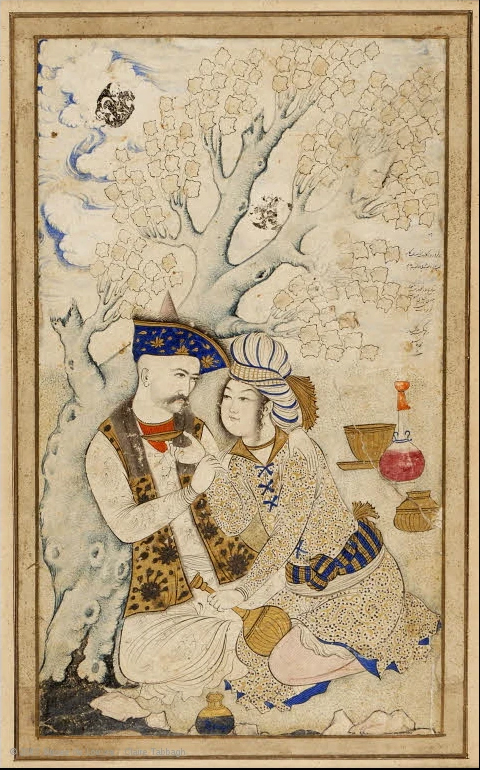
|
| Shah Abbas the Great and his Page, by Muhammad Qasim 1627 |
The Shah's painting studios of the Isfahan school, established under his patronage, produced some of the finest works of art in modern Iranian history, created by such illustrious painters as Reza Abbasi and Muhammad Qasim. He brought 300 Chinese potters to Iran to enhance local production of Chinese-style ceramics. Under Shah Abbas's reign, carpet weaving became an increasingly important part of Persian industry and culture, as wealthy Europeans began importing Persian rugs. Silk production became a royal monopoly, and ceramics also became an important export.
The Armenians who had escaped Ottoman persecution and had been forcibly relocated to Isfahan from their homeland in the Armenian Highlands were utilized by Shah Abbas. Once they were settled, he granted them considerable freedom and encouraged them to continue their silk production and other trades.
Shah Abbas transformed the empire, which had previously been held together largely by the loyalty of powerful and militant Qizilbash tribes, into a unified and stable monarchy. He strengthened the state by securing its borders, improving the economy, establishing a centralized administration, and creating a standing army (the Shahsavans) that reported directly to him rather than to tribal leaders. His keen economic and commercial understanding brought wealth and prosperity to the realm. Internal stability and consistent regulations encouraged agricultural growth, while infrastructure projects, including roads and public buildings, were undertaken on an unprecedented scale, enabling the flourishing of crafts and industries. As a skilled diplomat with a broad outlook, Shah Abbas sought political and economic ties with Western countries, and foreign ambassadors were warmly received at his court.
Shah Abbas was a Shi'a Muslim and held a particular veneration for Imam Hussein. He was relatively tolerant of Christianity within his realm. The Italian traveler Pietro Della Valle was astonished by the Shah's knowledge of Christian history and theology, and establishing diplomatic ties with European Christian states was an important part of the shah's foreign policy.
Consequently, he allowed Roman Catholic missions to be established in Persia and permitted the construction of churches and monasteries, although he forbade them from converting Muslims. However, he was less tolerant of Christians in Georgia and frequently demanded that Georgian nobles convert to Shi'a Islam.
Shah Abbas' tolerance toward most Christians was part of his broader policy of establishing diplomatic ties with European powers in an effort to enlist their support in the struggle against their common enemy, the Ottoman Empire.
In 1614, following a court intrigue involving several leading Circassians, Shah Abbas became suspicious of his eldest son, Crown Prince Mohammad Baqer Mirza. He ordered his execution in 1615, a decision he later regretted. Shah Abbas fell seriously ill in 1621. His second son and heir, Mohammad Khodabanda, believing that his father was on his deathbed, began preparing for his accession to the throne with the support of his Qizilbash allies. However, the shah recovered and punished his son by having him blinded, an act that disqualified him from ever ascending the throne.
Imam Qoli Mirza, the third and last of Shah Abbas's sons, then became the crown prince. Shah Abbas carefully prepared him for the throne, but in 1627 he had him partially blinded and imprisoned in Alamut. Shah Abbas favored his grandson Sam Mirza, the son of his executed eldest son, Mohammad Baqer Mirza.
Shah Abbas's health had been poor from 1621 onward. He died at his palace in Farahabad on the Caspian coast in 1629 and was buried in Kashan. Sam Mirza succeeded Shah Abbas in 1629 at the age of 17, taking the name Shah Safi.
Shah Abbas I is generally considered one of the greatest rulers in Iranian history and the history of the Safavid dynasty. He projected formidable military power, recovered much of the territory lost by his predecessors, and adopted a series of forward-looking policies aimed at strengthening the military, centralizing state authority, and expanding Iran's domestic and international commercial activities. He combined ruthlessness with a sense of justice, dealing harshly with threats to his power while remaining accessible to his subjects. These qualities ultimately led to his being styled Abbas the Great.
Bibliography:
- Safavid Government Institutions; by: Willem Floor; Mazda Publishers 2001.
- The Timurid and Safavid Periods Vol 6, The Cambridge History of Iran; Cambridge University Press 1986.
- Converting Persia: Religion and Power in the Safavid Empire; by: Rula Abisaab; I.B. Tauris Publishers 2003.
- The Politics of Trade in Safavid Iran: Silk for Silver 1600-1730 (Cambridge Studies in Islamic Civilization); by: Rudolph P. Matthee; Cambridge University Press 1999.
- Safavid Medical Practice: Practice of Medicine, Surgery and Gynaecology in Persia Between 1500 and 1750; by: Cyril Elgood; Luzac Publishers 1971.
- Iran Under the Safavids; by: Roger Savory; Cambridge University Press 1980.
- History of Iran's foreign affairs: from Safavids to the end of WWII; by: Abdulreza Houshang Mahdavi; Tehran, Amir Kabir Publishers 1996.