


Achaemenid Empire
By: Amir Majlesi Shirazi, 2002
|
|
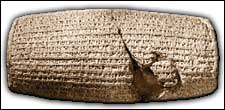
Cyrus Cylinder, The First Charter of Human Rights |
By 546 BCE, Cyrus the Great had defeated Croesus, the wealthy king of Lydia, and secured control over the Aegean coast of Asia Minor, as well as Armenia and the Greek settlements along the western Anatolian littoral. Turning eastward, he incorporated Parthia (not to be confused with Parsa in southwestern Iran), Chorasmia, and Bactria into his expanding domain.
In 539 BCE, he besieged and captured Babylon and subsequently released the Jewish population who had been held in exile there, an event that contributed to his later portrayal in the Book of Isaiah. At his death in 529 BCE, Cyrus’s empire extended as far east as the Hindu Kush in present-day Afghanistan.
His successors were less successful. Cyrus’s son, Cambyses II, conquered Egypt but died in July 522 BCE, either as the result of an accident or by suicide during a period of internal unrest. This turmoil was associated with a revolt led by a priest named Gaumata, who usurped the throne by claiming to be Bardiya, Cambyses’ brother. Bardiya is reported to have been secretly assassinated before Cambyses departed on his Egyptian campaign in 525 BCE. Gaumata’s rule was brought to an end in 522 BCE by Darius I, a member of a collateral branch of the Achaemenid royal family (also known in Old Persian as Darayavaush and later called Darius the Great).
Darius later launched campaigns against the Greek mainland, in response to support given by certain Greek city-states to rebellious subjects within the empire. However, following the Persian defeat at the Battle of Marathon in 490 BCE, Persian expansion in Europe was halted, and imperial control remained largely confined to Asia Minor.

|
| Map of Achaemenid Empire |
The Achaemenids thereafter consolidated areas firmly under their control. It was Cyrus and Darius who, by sound and farsighted administrative planning, brilliant military maneuvering, and a humanistic worldview, established the greatness of the Achaemenids and in less than thirty years raised them from an obscure tribe to a world power.
|
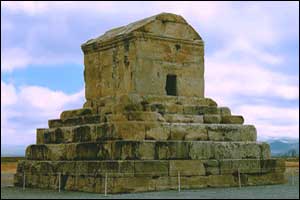
| Pasargad, Tomb of Cyrus the Great |
The Achaemenids thereafter consolidated the territories under their control. It was Cyrus and Darius who, through effective administrative organization and strategic military leadership, established the foundations of Achaemenid power. In less than thirty years, they transformed the Persians from a relatively minor group into a dominant imperial force.
The effectiveness of Achaemenid rule began to decline after the death of Darius I in 486 BCE. His son and successor, Xerxes I, was largely occupied with suppressing revolts in Egypt and Babylonia. He also launched an invasion of mainland Greece, but after initial success at Thermopylae, his forces were overextended and subsequently suffered decisive defeats at Salamis and Plataea.
By the time of the death of his successor, Artaxerxes I, in 424 BCE, the imperial court was increasingly affected by factional rivalries among collateral branches of the royal family. This internal instability persisted until the fall of the Achaemenid Empire in 330 BCE, when Darius III, the last Achaemenid ruler, was killed amid the collapse of his authority following Alexander’s conquest.
The Achaemenids governed through a system of regional administration often described as a form of enlightened despotism, allowing a degree of local autonomy under the satrapal system. A satrapy was an administrative unit, typically organized on a geographical basis. Each satrapy was governed by a satrap, or governor, while military authority was exercised by a separate general, and a state secretary maintained official records. Both the general and the secretary reported directly to the central government, providing a system of internal checks.
The empire’s approximately twenty satrapies were connected by an extensive road network of roughly 2,500 kilometers, the most famous section being the Royal Road from Susa to Sardis, constructed on the orders of Darius I. Relay couriers on horseback could travel to the most distant regions of the empire within approximately fifteen days.
Despite the relative autonomy granted by the satrapal system, royal inspectors—known as the “eyes and ears of the king”—regularly toured the empire to monitor local conditions and report back to the court. The king also maintained a personal bodyguard of 10,000 elite soldiers, commonly known as the Immortals.
|
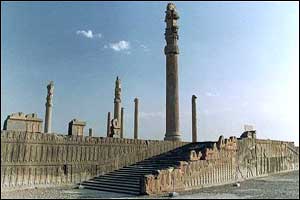
| The Perspolis, Capital of Achaemenid Empire |
The most widely used language in the empire was Aramaic, which served as a lingua franca across much of the Achaemenid administration. Old Persian functioned as an official royal language, but its use was largely restricted to monumental inscriptions and formal proclamations.
Darius I reorganized the imperial economy by introducing a standardized system of silver and gold coinage. Trade was extensive, and under the Achaemenids an efficient infrastructure facilitated the exchange of commodities across the vast territories of the empire. As a result of this commercial activity, several Persian words for common trade goods entered the languages of the Near East and, in some cases, later passed into English; examples include bazaar, shawl, sash, turquoise, tiara, orange, lemon, melon, peach, spinach, and asparagus. Trade constituted one of the empire’s principal sources of revenue, alongside agriculture and tribute.
Other achievements associated with Darius’s reign include the codification of laws, the establishment of a more unified legal framework that influenced later Iranian legal traditions, and the construction of the new ceremonial capital at Persepolis, where subject peoples presented their annual tribute during the festival of the spring equinox. In its art and architecture, Persepolis reflects Darius’s conception of imperial rule as the integration of diverse peoples into a single political order. The artistic style developed there is both distinctive and highly eclectic. Achaemenid artists drew upon the forms, traditions, and motifs of various Near Eastern cultures, combining them into a unified imperial aesthetic. This style is particularly evident in the iconography of Persepolis, which emphasizes the authority of the king and the institution of monarchy.
|
Achaemenian Kings: Achaemenes Teispes Cyrus I Cambyses I Cyrus II, The Great [550 - 529 BCE] Cambyses II [529 - 522 BCE] Smerdis, (the Magian) [522 BCE] Darius I, The Great [522 - 486 BCE] Xerxes I [486 - 465 BCE] Artaxerxes I [465 - 425 BCE] Xerxes II [425 - 424 BCE] Darius II [424 - 405 BCE] Artaxerxes II [405 - 359 BCE] Artaxerxes III [359 - 338 BCE] Arses [338 - 336 BCE] Darius III [336 - 330 BCE] |
|

See also
 Achaemenid Army
By: Professor A. Sh. Shahbazi
Immortals, (Elite regiment in the ancient Achaemenid empire)
By: Jona Lendering
The Art of Achaemenids, (The Art of Ancient Iran of Pre-Islamic era)
By: Edith Porada
Darius the Great's Inscription at Naqshe Rostam
Words of Darius in Bisotoun's Inscription
Royal Road, 5th century BCE
By: Jona Lendering
Histories of Herodotus, (A reference of Persian Empire of Achaemenian era)
By: Herodotus of Halicarnassus
Cyropaedia of Xenophon, The Life of Cyrus The Great
By: Xenophon
Anabasis of Xenophon, (A reference of Persian Empire of Achaemenian era)
By: Xenophon
Old Persian Cuneiform
The official script of the Achaemenid Empire