


The Great Persian Famine of 1917–1919
By Shapour Ghasemi 2026At the beginning of the twentieth century, Persia [*] was ruled by the Qajar dynasty, whose authority had been weakened by decades of political instability, financial dependence on foreign powers, and internal rivalries among government officials. Although the Constitutional Revolution of 1905–1911 established a parliament, the central government remained fragile and ineffective. As a result, much of the country lay beyond its control.
|
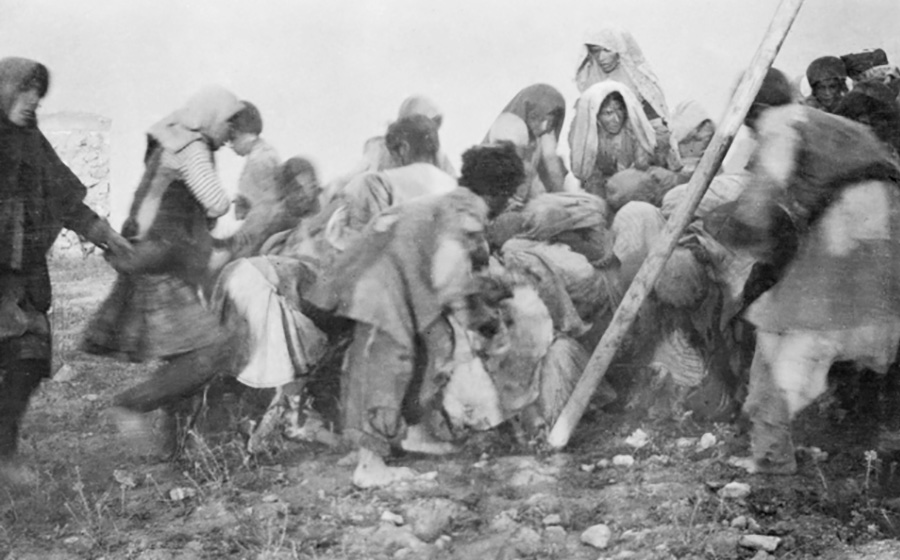
| Starving men and women struggle over the entrails from the daily slaughter of sheep during the Great Persian Famine of 1917–1919, Bijar, Persia [*]. |
When World War I began in 1914, Persia declared its neutrality. In practice, however, its neutrality proved impossible for the warring powers to respect. Russian forces occupied much of northern Persia, British troops occupied the south to impose their control over the oil fields of Khuzestan and to secure the route to India, and Ottoman armies invaded the western regions of the country. The movements and demands of these armies disrupted trade, devastated agricultural production, requisitioned food supplies, and displaced civilian populations.
As Russian troops withdrew following the Russian Revolution of October 1917, a power vacuum emerged across northern Persia, further destabilizing the region. Meanwhile, British occupation expanded from the south toward the north and west, increasing insecurity and contributing to the deterioration of the country's economic and humanitarian conditions.
Following the Russian withdrawal and the Ottoman defeats on several fronts, Ottoman forces began to withdraw from the western regions of Persia that they had occupied. Britain seized this opportunity to expand its military presence across much of the country and launched operations to drive the Ottoman forces back into Mesopotamia. These military campaigns required a constant supply of grain, livestock, and pack animals.
The British military occupation contributed significantly to the devastating famine of 1917–1919 through the large-scale requisitioning of grain and livestock, financial manipulation of local markets to benefit merchants aligned with the British authorities, and restrictions on transportation that disrupted the movement of food between regions. British military operations also severely affected agricultural production and food distribution. Roads became unsafe, limiting the transport of food from surplus regions to areas experiencing shortages.
In addition to the British military presence and what many observers and historians have described as a lack of humanitarian concern and empathy, British forces carried out the large-scale confiscation of grain and livestock, leaving many farmers without sufficient food or resources to survive. At the same time, several regions experienced poor harvests due to drought and adverse weather conditions, including reduced rainfall. These conditions significantly lowered grain production, depleted food reserves, and caused livestock losses that further weakened rural economies.
Although severe droughts triggered the initial crop failures, British wartime policies exacerbated the crisis by transforming a natural food shortage into a humanitarian catastrophe through restrictions on imports, the monopolization of transportation, and the prioritization of military logistics over humanitarian relief. The combined effects of food requisitioning, disrupted transportation, market distortions, and declining agricultural production led to widespread starvation, disease, economic collapse, and social upheaval. The famine of 1917–1919 became one of the deadliest humanitarian disasters in modern Iranian history. Estimates of the death toll vary considerably among historians, ranging from several million to as many as 8–9 million people out of a population of approximately 18 million.
|
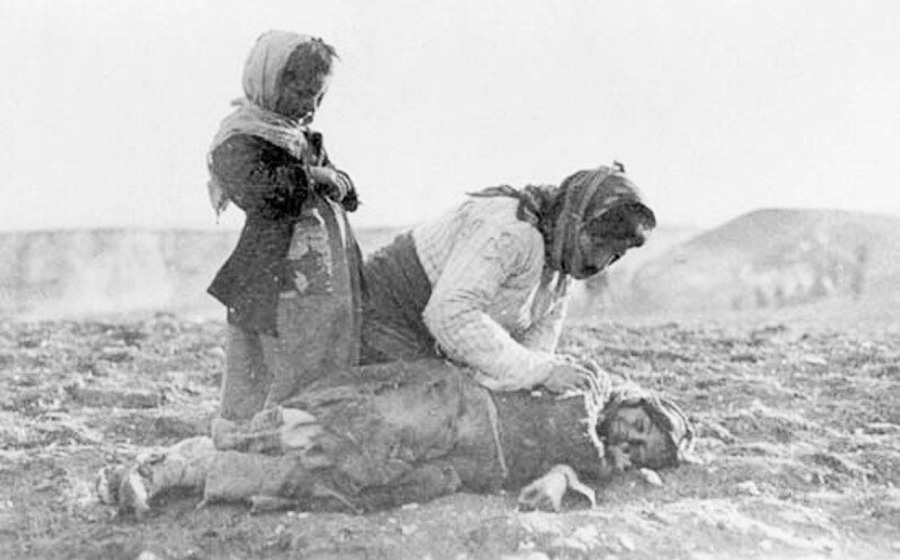
| A starving woman during the Great Persian Famine of 1917–1919, Bijar, Persia [*]. |
The wartime economy generated severe inflation, causing grain prices to rise dramatically and making staple foods unaffordable for much of the population. At the same time, many merchants and landowners hoarded grain in anticipation of higher prices, further reducing supplies available in local markets.
The weakness of the Persian government severely limited its ability to regulate prices, prevent hoarding, or organize effective famine relief. As a result, food shortages intensified and many communities were left without adequate assistance.
Starvation and widespread malnutrition weakened immune systems, making the population highly vulnerable to infectious diseases. Epidemics of cholera, typhus, dysentery, influenza, and malaria spread rapidly through malnourished communities, further increasing mortality.
The global influenza pandemic of 1918, commonly known as the Spanish flu, further compounded the crisis, claiming the lives of many people whose health had already been severely weakened by prolonged hunger.
The famine devastated nearly every aspect of Persian society. Entire villages were abandoned as residents fled in search of food and better living conditions. Families sold their livestock, farmland, and personal possessions to survive. The period was marked by widespread malnutrition, large numbers of orphaned children, homelessness, and disproportionately high mortality among the elderly and the poor.
Urban centers also suffered as food prices rose beyond the reach of ordinary workers. Bread shortages frequently sparked social unrest, while charitable organizations and religious institutions struggled to meet the growing demand for assistance.
|
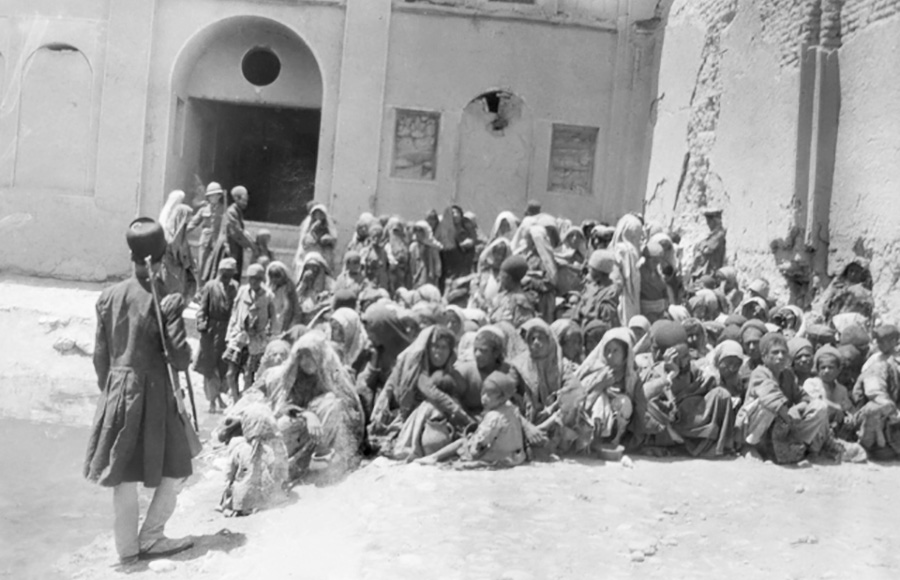
| Starving men, women, and children waiting for a distribution of stew during the Great Persian Famine of 1917–1919, Bijar, Persia [*]. |
The famine further weakened the already fragile Qajar government. Public confidence in state institutions declined as the authorities proved unable to coordinate effective relief efforts or restore economic stability. The crisis also deepened Persia’s dependence on foreign powers, particularly Britain, which expanded its political influence during and immediately after the war.
Economic recovery remained slow. Agricultural production took several years to recover, while inflation and widespread poverty persisted into the early 1920s. The last British troops withdrew from Iran only in 1921, three years after the end of World War I. During and after the Great Persian Famine (GPF), British officials portrayed themselves as providing humanitarian assistance while rejecting accusations that British wartime policies had contributed to the famine. Instead, they attributed the crisis primarily to the weakness and ineffectiveness of the Persian government. The broader political and economic instability contributed to developments that ultimately culminated in Reza Khan's coup of 1921 and the establishment of the Pahlavi dynasty in 1925.
Despite the significance and scale of the Great Persian Famine, it has received relatively little international attention compared with other humanitarian crises of the twentieth century. The involvement of the British Empire has contributed to the limited attention the famine has received from international institutions and within the broader historiography. This has hindered wider recognition of the role of foreign intervention and the conduct of the British occupation authorities during the crisis, raising important questions about the consistency with which historical humanitarian disasters have been acknowledged and studied.
* On 21 March 1935, the country's official name was changed from Persia to Iran.
Bibliography:
- Ervand Abrahamian. A History of Modern Iran. Cambridge: Cambridge University Press, 2008.
- Mohammad Gholi Majd. The Great Famine and Genocide in Persia, 1917–1919. Lanham, MD: University Press of America, 2003.
- British National Archives. Foreign Office (FO 371) records relating to Persia during the First World War.